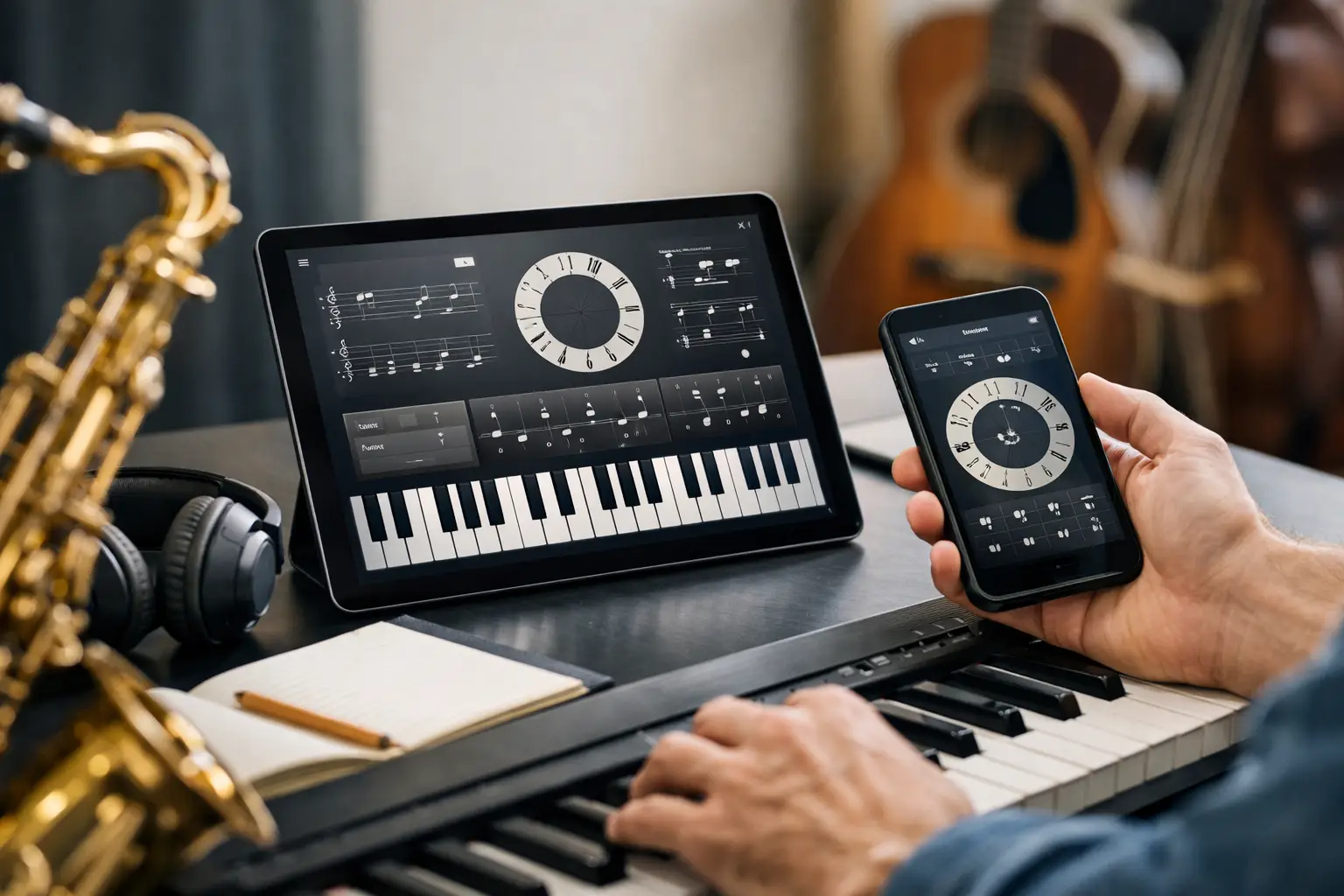
If you have ever opened a jazz theory app, tapped around for five minutes, and thought, this is either too shallow or way too dense, you are not imagining it. The best jazz theory apps do something rare: they turn abstract ideas into repeatable practice, so you can hear a sound, recognize a pattern, and use it on purpose.
That matters because jazz theory is not just information. It is a language. And like any language, it sticks when you interact with it often, in small chunks, with enough structure to notice what is changing. A good app can help with that. A bad one just gives you more screens to ignore.
What makes the best jazz theory apps actually useful?
The first question is not whether an app has a huge library. It is whether it helps you build fluency. That means connecting symbols, sounds, shapes, and functions in a way that is easy to revisit. If an app teaches altered dominants but never asks you to identify them by ear, spell them, or place them in context, you are mostly collecting facts.
The strongest apps usually do at least one of three things well. They train your ear around harmony and melodic function, they organize theory into a progressive system, or they make repetition feel rewarding enough that you keep coming back. The sweet spot is an app that combines all three.
There is also the question of instrument. Some apps are more helpful for pianists because harmony is visually obvious on a keyboard. Others are better for horn players or guitarists because they emphasize hearing, vocabulary, and function over shapes. So the right choice depends on what you need right now, not just on which app claims to cover everything.
Best jazz theory apps by learning style
1. The Jazz Puzzle
If your biggest problem is consistency, this kind of app makes a lot of sense. The Jazz Puzzle approaches theory as an interactive system rather than a digital textbook. Instead of treating jazz as a pile of disconnected concepts, it frames the material as pieces of a language that can be learned progressively through recognition, recall, and pattern-based practice.
That approach is especially useful for players who know a little theory but struggle to internalize it. Puzzle-style interaction creates a loop: see it, hear it, identify it, repeat it. That is a stronger learning cycle than simply reading definitions and moving on. For beginners, it lowers the intimidation factor. For more advanced players, it can sharpen weak spots that usually get skipped.
The trade-off is that learners who want a traditional lesson format with long explanations may need a little time to adjust. But if you want theory to feel active instead of static, this style is hard to beat.
2. Tenuto
Tenuto is one of the cleanest musicianship apps available, and it earns its place because it does the fundamentals very well. It is not jazz-specific in branding, but it is extremely useful for jazz students who need faster note reading, interval recognition, chord spelling, scale work, and ear training.
Its strength is focus. You can drill one concept at a time without much friction, and that makes it a strong support tool for jazz theory. If your harmonic understanding is slowed down by basic fluency gaps, Tenuto helps close them.
Its limitation is context. It will not hold your hand through jazz language or show you why a sound matters in jazz harmony. It is better as a practice engine than as a complete jazz learning environment.
3. Functional Ear Trainer
A lot of jazz players do fine when reading chord symbols but freeze when they have to recognize harmonic pull by ear. Functional Ear Trainer is useful because it trains relationships to a tonal center rather than isolated pitch guessing. That is a practical way to hear music.
For jazz students, this can improve how you hear tension and resolution, how you anticipate melodic targets, and how you make sense of harmonic motion. It is not a full theory app in the broadest sense, but it supports one of the most important parts of theory: hearing function, not just naming notes.
The catch is that it is narrower than some players expect. If you want chord-scale charts, voicing ideas, and written explanations, this is not that app. If you want better ears, it is very solid.
4. Complete Ear Trainer
Complete Ear Trainer offers a wider set of drills and a more gamified structure than many older ear training tools. That makes it appealing for musicians who need variety to stay engaged. You can work on intervals, chords, scales, cadences, and more, which gives it real value for jazz learners building broad recognition skills.
Its biggest advantage is momentum. Short exercises and progressive levels make daily practice easier to maintain. And daily practice is where theory starts turning into instinct.
Still, broad coverage can feel generic. It helps with musical hearing, but jazz-specific application is something you have to bring yourself. Think of it as strong conditioning, not the whole sport.
5. iReal Pro
This one sits slightly outside the theory-app label, but it belongs in the conversation because of how often musicians use it to test theory in real time. iReal Pro gives you harmonic frameworks to practice over, transpose, loop, and slow down. That makes it a practical lab for hearing functions, trying voicings, and checking whether a concept actually makes sense on your instrument.
It is especially helpful once you already understand a concept and want to apply it. For example, if you are learning voice leading, chord tones, or tensions, it gives you a repeatable environment to experiment in.
On its own, though, it does not teach much. It is better for application than explanation. If you are brand new to jazz theory, you will probably want something more guided alongside it.
6. Piano Companion
For pianists and composers, Piano Companion can be surprisingly handy. It works as a chord and scale dictionary with reverse lookup features, which is useful when you find a shape or sound and want to name it quickly. Jazz learners often run into unfamiliar sonorities, and this kind of tool helps reduce that friction.
It is most useful as a reference app, not a curriculum. That means it can speed up your workflow and help you organize harmonic information, but it will not necessarily teach you how to think in the language. It answers what is this, more than why does this work.
7. SoundGym
SoundGym is broader than jazz theory, but it targets listening accuracy in a way that can support serious musical development. Many of its games focus on frequency, balance, and sonic detail, which makes it especially relevant for producers and recording-minded musicians who also want stronger ears.
For straight-ahead jazz theory study, it is less direct than other apps here. But if your goal includes hearing more clearly, noticing texture, and improving attention to sound, it can be a valuable supplement. The downside is obvious: it does not organize jazz harmony for you.
8. Music Theory Pro
Music Theory Pro gives you a more traditional theory-study experience. Lessons, exercises, and quizzes cover notation, scales, chords, intervals, and harmonic basics in a straightforward way. That can be useful if you want to patch holes in your foundation before tackling more advanced jazz material.
Its main value is clarity. It gives you the grammar before you try to speak fluently. For some learners, that is exactly what is needed.
But if your goal is specifically jazz fluency, general theory apps can feel a little detached. You may understand the rules better without getting much closer to hearing or using the language naturally.
9. EarMaster
EarMaster has been around for a long time, and that longevity shows in the depth of its training options. It covers rhythm, intervals, chords, melodies, sight-singing, and more, with a level of structure that many serious students appreciate. For jazz learners who want a fuller training environment, it can be one of the most complete choices.
The benefit is range and rigor. The trade-off is that it can feel a bit academic if you are looking for something light, fast, and playful. Some musicians love that. Others lose momentum with apps that feel too much like school.
How to choose the best jazz theory apps for you
If you are a beginner, prioritize apps that reduce overload. You do not need every topic at once. You need a system that helps you recognize core materials repeatedly until they feel familiar. Apps with short exercises, progressive levels, and strong feedback loops tend to work best.
If you are intermediate, the biggest question is usually transfer. You may already know the names of things. What you need is an app that helps those ideas show up in your ear, your hands, and your decisions while playing. Interactive practice and applied listening matter more here than big libraries of information.
If you are advanced, specialization matters. One app might sharpen your ear. Another might function as a harmonic sketchpad. Another might help you clean up weak spots in recall. At that level, the best setup is often two complementary apps rather than one app that tries to do everything.
A better standard for jazz learning tools
The real test is simple: does the app make you better at recognizing and using the language, or does it just make you feel busy? The best jazz theory apps create momentum. They make practice easier to start, easier to repeat, and easier to retain.
That is why the most effective tools are not always the ones with the most features. They are the ones that turn confusion into pattern recognition and pattern recognition into confidence. When an app helps you hear more clearly and respond more quickly, theory stops feeling like homework and starts feeling usable.
Choose the tool that makes you want to come back tomorrow. That is usually the one that changes your playing.