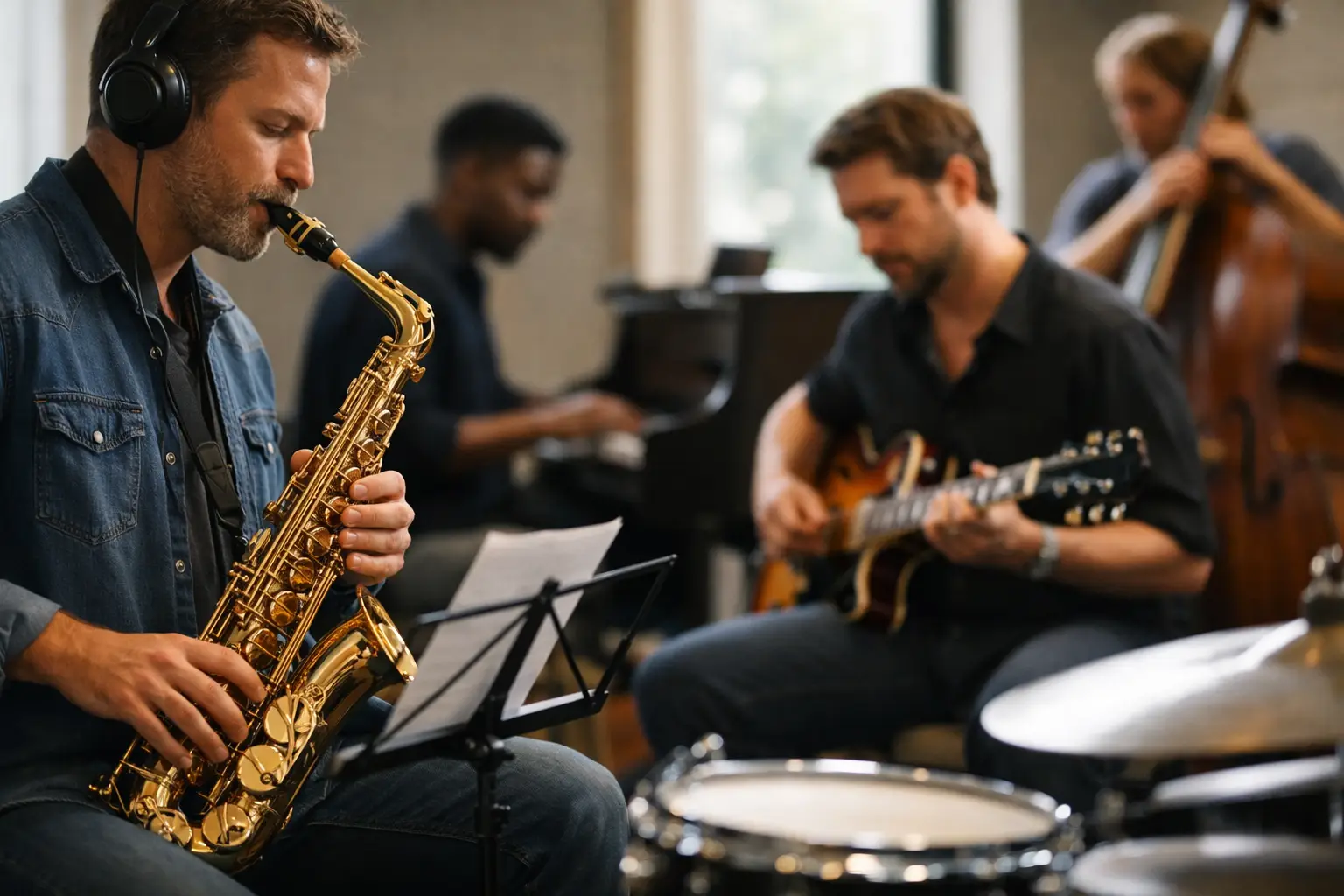
A lot of players think improvisation gets better when they simply play more. Then they spend 45 minutes running lines they barely hear, lose the form, and finish practice feeling busy but not better.
If you want to know how to practice jazz improvisation, the key is not squeezing in more random soloing. It is building a routine that trains recognition, recall, and response. Jazz fluency works more like language than raw athletic repetition. You need material to absorb, patterns to organize, and enough repetition to make your choices feel natural.
How to practice jazz improvisation without guessing
The fastest way to stall is to make every practice session a test. Improvisation practice should be more like lab work. You isolate one element, repeat it enough to understand it, and then place it back into real musical time.
That means a good session usually has three layers. First, you learn a small piece of vocabulary or a concept. Next, you manipulate it so it is not stuck in one key or one fingering. Then you use it in a short improvisation setting where you can hear whether it actually belongs in your playing.
This is also where many players get frustrated. They mix ear training, theory, technique, time feel, and creativity into one giant task. When everything is being tested at once, it is hard to tell what is actually weak. Separating the pieces does not make your playing less musical. It makes your practice more honest.
Start with smaller musical units
A common mistake is trying to improvise over long harmonic sequences before you can clearly hear and control one short idea. Start with compact material. A two-note rhythm, a three-note shape, a short enclosure, or a simple guide tone line is enough.
Why so small? Because improvisation happens in real time. If the idea is too large to hear, remember, and place rhythmically, it will not become usable language. Smaller units are easier to transpose, easier to sing, and easier to recognize when they show up in other contexts.
One strong exercise is to take a tiny phrase and run it through four stages. First, play it exactly as learned. Second, change the rhythm while keeping the notes. Third, change the ending while keeping the opening. Fourth, answer it with a contrasting phrase. That turns one fragment into a whole practice ecosystem.
This is where puzzle-style learning can be powerful. When you treat jazz language as pieces you can sort, match, and reassemble, the material starts to feel less foggy and more playable.
Build your routine around four skills
If your practice is unbalanced, your improvisation will be too. Most players need work in four areas at the same time: rhythm, ear, vocabulary, and harmonic awareness.
Rhythm comes first
Weak rhythm can make good note choices sound unconvincing. Strong rhythm can make simple note choices sound intentional. So before adding more harmonic complexity, make sure your time feel is stable.
Practice placing short phrases in different parts of the bar. Start an idea on beat one, then on the and of one, then on beat two. Leave space after each phrase. Repeat one rhythm with different note sets. This trains control instead of reflex.
It also helps to reduce the pitch information. Clap a rhythm, speak it, then play it on one note. If the phrase only works when the notes distract from the time feel, it is not really working yet.
Train your ear while you practice
If you cannot sing an idea, you probably do not own it. That does not mean you need perfect pitch or advanced solfege. It just means the ear has to be included, not added later.
Sing short lines before you play them. Sing guide tones against a progression. Sing the root movement, then the third and seventh. When you do play, listen for function, not just finger shape. Ask yourself what you are hearing: tension, release, color, direction.
A useful test is this: can you hear the next note before your hands play it? If not, slow the task down. Improvisation improves when your ear starts making more of the decisions.
Learn vocabulary in families
Random licks create random results. Instead, group ideas by function. Practice phrases that target thirds, phrases that approach chord tones chromatically, phrases built from arpeggio fragments, and phrases that emphasize upper extensions. Organizing vocabulary this way helps you recognize when each sound makes sense.
This matters because two phrases may use similar notes but do very different jobs. One may create momentum into a chord tone. Another may sit more horizontally and smooth out the harmony. When you understand the job of the phrase, you are much more likely to use it with intention.
Keep harmony practical
Harmony can easily become too abstract. You do not need to think about ten possible scale options every measure. In practice, focus on a few dependable reference points: roots, thirds, sevenths, and clear resolutions.
For many players, guide tone lines are the turning point. They simplify the harmony enough for the ear to follow, while still sounding connected to the changes. Once those are solid, you can surround them with passing tones, approach notes, and rhythmic variation.
Use constraints to make improvisation easier
Freedom sounds great until you are faced with unlimited choices. Constraints reduce panic and increase focus.
Try improvising with only chord tones. Then only with four-note phrases. Then only using one rhythmic cell for a chorus. Then only resolving to the third of each chord. These limits may sound restrictive, but they train deep control. And oddly enough, controlled limitation often produces more musical ideas than unrestricted wandering.
There is a trade-off here. If you stay in constraint mode too long, your playing can get stiff. So alternate between focused exercises and brief free-playing windows where you let the concept breathe.
How to practice jazz improvisation so ideas stick
The biggest practice problem is not learning. It is forgetting.
A phrase you play twenty times today can disappear by Thursday if you never retrieve it. That is why review matters. Jazz vocabulary needs spaced repetition. Come back to ideas after a day, after three days, and after a week. Reuse them in new keys, tempos, and rhythmic placements.
This is one reason interactive systems work so well. They force recall instead of passive recognition. Seeing a concept once is not enough. You want to recognize it, name it, hear it, and use it. The Jazz Puzzle leans into this by making the learning process feel active, almost game-like, which is exactly what helps concepts move from short-term memory into real fluency.
A simple 30-minute session that works
A useful jazz improvisation session does not need to be long. It needs to be organized.
Spend the first 5 minutes on rhythm. Clap or play one-note patterns with a metronome and place them in different parts of the measure. Spend the next 10 minutes on one vocabulary item. Learn it, sing it, transpose it, and alter the rhythm. Spend 10 minutes applying it over a short harmonic loop or progression, with clear limits on what you are trying to use. Use the last 5 minutes to record yourself and listen back.
That last step matters. What feels fluent while playing may sound rushed, vague, or repetitive on playback. Recording removes the guesswork.
If you have more time, do not just double everything. Add a second concept or revisit older material. Practice should accumulate, not reset every day.
What advanced players still practice
At a higher level, the work does not become less basic. It becomes more precise.
Advanced players still refine time feel, phrase length, voice leading, and ear-to-hand response. The difference is that they hear subtler problems. Maybe the lines are harmonically clear but rhythmically predictable. Maybe the language is strong in medium tempo but stiff at slow tempos. Maybe the ear can hear altered color, but the phrasing does not land naturally yet.
So if you are more experienced, do not skip foundational work because it feels too easy. Simple material under stricter conditions is often where the real improvement hides.
The goal is not more information
Jazz practice can turn into endless collecting. More scales, more patterns, more theory, more transcriptions. Some of that is useful. But improvisation gets better when information becomes response.
That means your practice should help you recognize a sound quickly, recall it without strain, and shape it in time. If a concept does not move closer to that goal, it may be interesting, but it is not helping enough yet.
A good session should leave you with one thing that feels more usable than it did yesterday. That is real progress. Keep stacking those small wins, and improvisation starts to feel less like guessing and more like speaking.