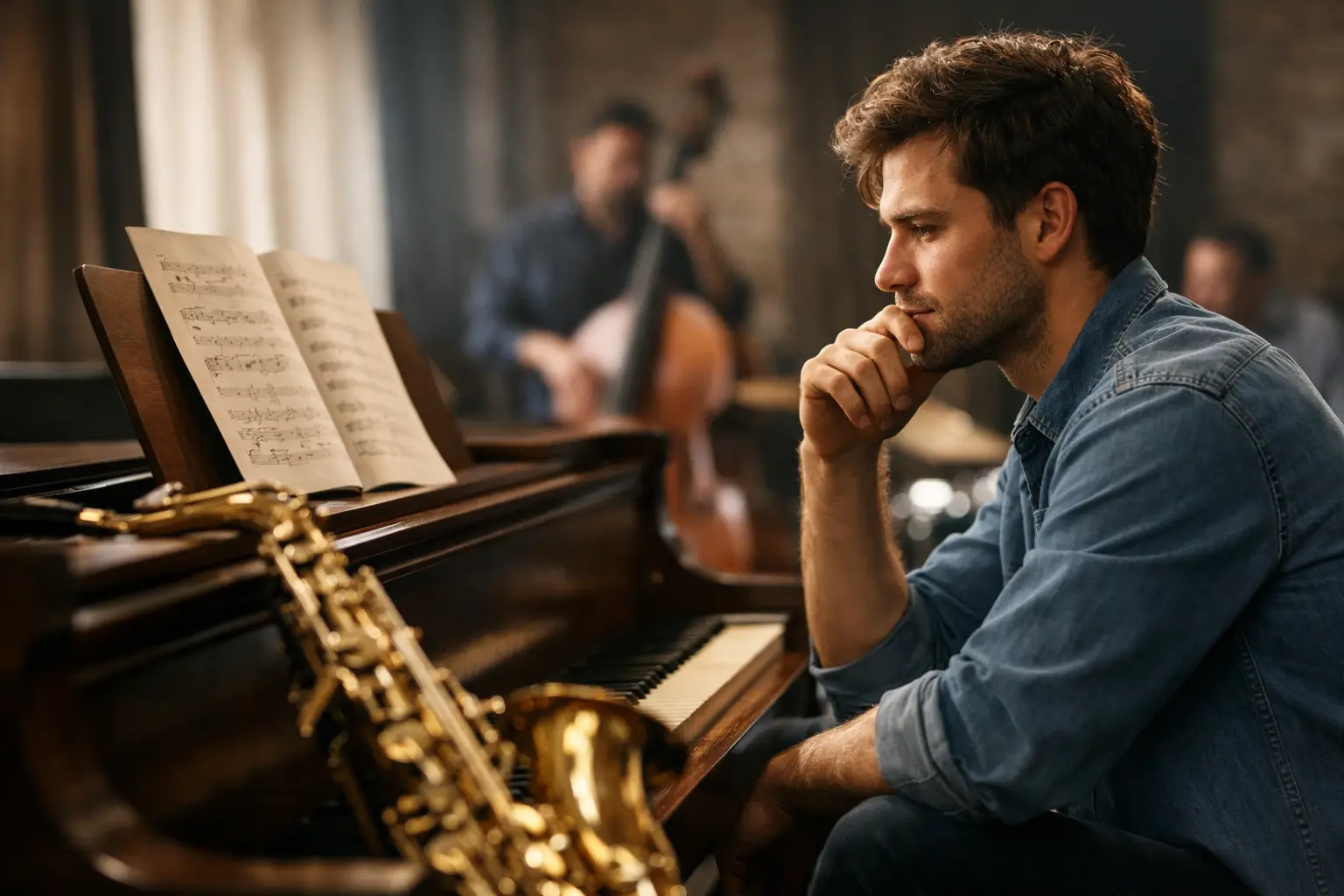
A lot of musicians ask, is jazz hard to learn, when what they really mean is this: why does it feel so different from everything else I have practiced?
That feeling is real. Jazz can seem harder than other styles at first because it asks you to do more than play correct notes. You are learning a musical language. That means hearing patterns, recognizing harmony in motion, reacting in real time, and building ideas that sound connected instead of random. The good news is that languages become much less intimidating once you stop treating them like a pile of facts and start learning them as small, usable pieces.
Is jazz hard to learn for beginners?
For beginners, jazz is usually hard in a very specific way: not because every concept is impossible, but because several skills have to grow together. In many styles, you can get pretty far by memorizing parts and repeating them accurately. Jazz asks for memory too, but it also asks for recognition, flexibility, and decision-making.
That is why a brand-new jazz student often feels overwhelmed. You might learn a chord type, then hear someone talk about guide tones, then see altered dominants, then be told to improvise over a progression. None of those ideas is unreachable on its own. The challenge is that jazz connects them all.
Still, beginners often underestimate what becomes easier quickly. You can start hearing common chord movement. You can learn to spot a phrase shape. You can recognize the sound of tension and release. You can build a small vocabulary and use it right away. That early traction matters because jazz does not have to be all-or-nothing.
What actually makes jazz feel difficult
Jazz has a reputation for being elite, mysterious, or reserved for naturally gifted players. That reputation does more damage than the music itself. Most of the difficulty comes from how jazz is usually presented.
Too often, students get a dense theory dump before they get a usable system. They are shown scales, chords, substitutions, extensions, and rhythmic ideas without a clear order of operations. That creates a strange kind of frustration: you are learning things, but nothing feels playable yet.
The real obstacles tend to be more practical.
You need active listening, not just finger memory
In jazz, your ears do a lot of the work. You are not only executing material. You are identifying sound relationships. When harmony changes, your ear has to track where the line is sitting and where it wants to go. If you have mostly practiced by visual shapes or muscle memory, this can feel slow at first.
Improvisation exposes weak spots fast
Improvisation is honest. If your rhythm is shaky, it shows. If you do not hear the harmony clearly, it shows. If your vocabulary is thin, it shows. That can make jazz feel harsher than other styles, even though it is really just more revealing.
There is a language problem
Every style has vocabulary. Jazz just makes that fact impossible to ignore. If you do not know the common melodic shapes, rhythmic habits, and harmonic signals, your playing can sound disconnected. Many students think they need more talent when they really need more language input.
Progress is uneven
One week you understand a concept and feel great. The next week you try to apply it in real time and feel lost again. That is normal. Jazz learning is rarely linear because recognition, recall, technique, and creativity do not all develop at the same speed.
Why jazz is not as hard as people think
Jazz gets easier when you stop treating it like a giant mountain and start treating it like pattern recognition.
A major shift happens when you realize that jazz is built from recurring ideas. Chord qualities repeat. Voice-leading patterns repeat. Rhythmic cells repeat. Phrases answer each other in familiar ways. Even advanced players are not inventing from nothing every second. They are combining and reshaping things they know deeply.
This is why structured repetition works so well. When you interact with concepts again and again in short, focused ways, they stop feeling abstract. You begin to recognize them on sight, hear them faster, and use them without freezing. That is very different from reading about a concept once and hoping it appears in your playing later.
In other words, jazz is hard if your learning method is vague. It becomes much more manageable when the material is organized into bite-sized patterns you can identify, test, and recall.
The parts of jazz that usually come first
Not everything in jazz is equally difficult. Some skills deliver more progress than others, especially early on.
Rhythm is one of them. A simple phrase with good time, clear accents, and a strong shape often sounds better than a complex idea played stiffly. Harmony matters, but rhythm is what makes the language feel alive.
Basic chord function is another. You do not need to memorize every possible extension to start hearing how chords behave. Once you can hear movement and tension more clearly, your improvising gets more logical.
Then there is vocabulary. This is where many players either grow fast or get stuck. If you only collect theory facts, your playing stays theoretical. If you collect short musical ideas you can hear, sing, recognize, and move through different keys, the language starts becoming available in real time.
How to make jazz easier to learn
The fastest way to make jazz feel less hard is to reduce friction. That means fewer disconnected tasks and more repeatable interactions with the same material.
Start with small units. A short phrase. A single harmonic idea. One voicing type. One melodic pattern over one common chord sound. Make it recognizable before you try to make it impressive.
Next, practice for recall, not just exposure. Seeing a concept once is not learning it. You want to be able to identify it, hear it internally, and retrieve it when you need it. That is why puzzle-style learning can be so effective. It turns recognition into a skill, not just a hope. Instead of passively reading theory, you actively match, sort, hear, and retrieve the language until it sticks.
It also helps to separate your practice modes. Spend some time identifying sounds. Spend some time building technique. Spend some time improvising with tight limits. If you try to train every skill at once, jazz can feel chaotic. If you isolate the job of each practice block, progress becomes easier to notice.
Is jazz hard to learn if you already play another style?
Sometimes yes, sometimes no.
If you already have good rhythm, solid technique, and a trained ear, you have a real head start. You know how to practice, and that matters more than people think. But if your background is heavily dependent on written parts or fixed patterns, jazz may still feel uncomfortable because it asks for faster musical decision-making.
Players from classical backgrounds often adjust well to discipline and detail, but may need time with feel, flexibility, and spontaneous phrasing. Players from rock or pop backgrounds may adapt quickly to groove and ear-based learning, but may need more harmonic organization. Neither path is better. They just produce different strengths and blind spots.
That is why the answer depends less on where you came from and more on whether you are willing to learn jazz on its own terms. It is a language. Knowing one language helps, but it does not replace learning new vocabulary and grammar.
A better question than is jazz hard to learn
A more useful question is, what kind of practice makes jazz click faster?
Usually, it is not more information. It is better interaction. You need a system that helps you notice patterns, connect ideas, and revisit them often enough that they become familiar. That is where many musicians finally relax. They realize jazz is not testing whether they are special. It is training whether they can recognize and use the language consistently.
That shift changes everything. The goal stops being to understand all of jazz at once. The goal becomes to learn one piece well enough that it stays with you, then add the next piece, then the next. A platform like The Jazz Puzzle fits that mindset well because it treats fluency like something you build through repeated, engaging contact rather than pressure and overload.
So, is jazz hard to learn? It can be. But hard does not mean out of reach. It usually means the material needs better structure, better sequencing, and more active repetition than you may have used before. Once that clicks, jazz starts feeling less like a wall and more like a conversation you are gradually learning to join.
Keep your practice small enough to win, clear enough to repeat, and musical enough to enjoy. That is where real jazz growth starts.