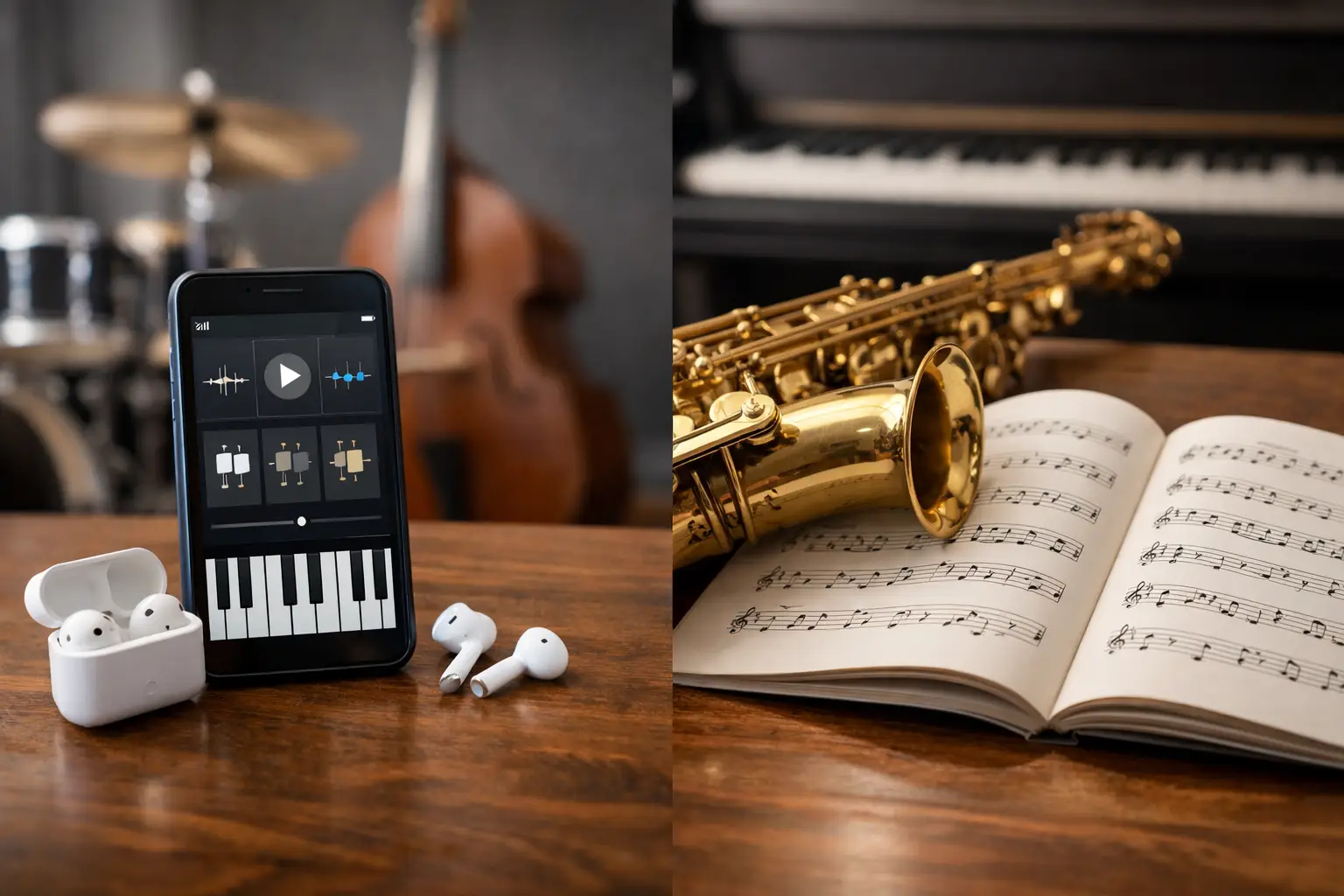
Open a method book and you usually get a clean sequence of pages, examples, and explanations. Open an app and you expect interaction, feedback, and momentum. That is the real tension in jazz app vs method book. It is not just old versus new. It is static learning versus active recall, explanation versus response, and reading about jazz versus practicing how jazz language actually sticks.
For most musicians, the better question is not which format looks more serious. It is which format helps you recognize sounds faster, remember ideas longer, and return tomorrow ready to keep going. Jazz is learnable, but it asks for repetition, pattern recognition, and clear organization. The format you choose changes how easily that happens.
Jazz app vs method book: the real difference
A method book is designed to present information. At its best, it gives you a thoughtful path through harmony, rhythm, ear training, voicings, lines, and vocabulary. A strong author can save you years of confusion by organizing ideas in the right order. Books are often excellent at naming concepts and showing the logic behind them.
A jazz app is designed to create interaction. Instead of only showing the material, it can ask you to identify it, sort it, recall it, and apply it repeatedly. That changes the learning experience in a big way. When you must make choices, test your memory, and notice patterns in real time, the material moves from something you understand intellectually to something you can actually use.
This is where many players get stuck with books. They read a chapter, nod along, and feel productive. Then they sit down to play and realize the idea is still slippery. They saw it, but they did not internalize it. Books can absolutely teach jazz. But by themselves, they often leave a gap between exposure and fluency.
Where method books still shine
Method books are not outdated. They are just incomplete for certain kinds of learning.
A good book gives you depth. It can slow down and explain why a sound works, how a concept developed, or how one idea connects to the next. That matters, especially if you like understanding the system behind the music. Books also let you move at your own pace without notifications, screens, or distractions. Some musicians simply focus better with paper, pencil, and an instrument.
There is also a practical advantage. A book can be easier to annotate, mark up, and revisit over time. Many players build a long-term relationship with a favorite book because it becomes part reference guide and part practice journal.
The trade-off is that books usually cannot respond to you. They do not know what you missed, what you remembered, or what you need to review again today. They present material the same way whether you are confused, overconfident, or forgetting half of what you studied last week.
Why apps often work better for retention
If your goal is real jazz fluency, retention matters more than exposure. You do not need one more page of information if you cannot recall yesterday's material when you play.
That is where apps have a clear edge. Interactive tools can turn learning into repeated recognition and retrieval. Instead of passively reading about intervals, chord qualities, progressions, or melodic shapes, you engage with them. You answer, compare, sort, and repeat. That process is closer to how memory actually forms.
An app can also make small practice sessions easier to sustain. Ten focused minutes of active work often beats forty minutes of vague study. When the experience is structured and a little game-like, you are more likely to keep showing up. That is not a gimmick. Consistency is one of the biggest factors in jazz growth, and motivation matters.
This is especially useful for players who have started and stopped jazz study multiple times. If a format feels heavy, abstract, or hard to enter, you delay practice. If it feels clear and rewarding, you begin sooner and repeat more often. Over months, that difference is huge.
The weakness of apps
Apps are not automatically better. Some are shallow, flashy, or too fragmented. They may give you quick wins without building a strong mental map of the material. Others lean so hard on convenience that they stop asking for real thought.
A useful jazz app needs structure. It should help you organize concepts, revisit them in a purposeful sequence, and build recognition over time. If it only offers random drills, your learning can become scattered. You may improve at the app without improving your actual musicianship.
That is why the design philosophy matters. The best tools do not just entertain. They organize the language of jazz into repeatable exercises that train recall, understanding, and connection. They make difficult material more approachable without watering it down.
Who benefits most from a method book
If you are highly self-directed, already disciplined, and good at designing your own practice process, a method book can still be a strong primary resource. Advanced players often know how to convert written material into exercises, ear work, and instrumental application. For them, a book can be raw material for serious study.
Books also suit learners who want long-form explanation before doing anything interactive. If you need a concept fully spelled out first, reading can reduce confusion and give you confidence.
But even in these cases, books work best when the player adds some active layer on top. That might mean singing, transposing, writing, or testing memory away from the page. Without that second step, understanding often stays theoretical.
Who benefits most from a jazz app
A jazz app is often the better fit for beginners, busy adult learners, and musicians who have felt overwhelmed by traditional materials. It helps when you want the subject broken into manageable parts and practiced through repetition instead of absorbed through long reading sessions.
It is also ideal for players who need momentum. If you want a system that nudges you into daily contact with the language, interactive design can make a real difference. Clear feedback and small wins reduce the friction that keeps people from practicing.
That does not mean apps are only for newer players. Intermediate and advanced musicians can benefit just as much when the app trains speed of recognition, memory, and conceptual clarity. In jazz, knowing something is not the same as accessing it quickly. Interactive practice sharpens access.
The best answer is often both, but not equally
Saying both are useful is true, but it can also be too vague to help. Most musicians do not need a perfect fifty-fifty balance. They need to know which format should carry the weight.
If your main problem is confusion, a book may help clarify the landscape. If your main problem is inconsistency, poor retention, or difficulty internalizing concepts, an app should probably do more of the heavy lifting.
For many modern learners, the strongest combination looks like this: use a book for deeper explanation when needed, and use an interactive tool for the daily work of recognition, recall, and review. That order matters. Fluency grows from doing, not just understanding.
This is also why puzzle-style learning makes so much sense for jazz. Jazz language is built on patterns, relationships, categories, and context. When you practice those actively, you begin to see the system more clearly. It stops feeling mysterious and starts feeling organized. The Jazz Puzzle is built around that idea, which is why the experience feels less like trudging through theory and more like training your musical instincts on purpose.
So which works better?
In a straight jazz app vs method book comparison, the app usually wins for engagement, retention, and consistency. The book usually wins for depth of explanation and long-form reference. If you only have time, energy, or budget for one, choose based on the bottleneck in your learning.
If you keep reading but not retaining, choose the app. If you keep forgetting concepts between practice sessions, choose the app. If jazz has felt intimidating because the material seems dense and disconnected, choose the app.
Choose the book when you already have strong practice habits and mainly need a well-organized source of information. Choose the book when you are comfortable turning written ideas into active exercises on your own.
The key is to be honest about what actually moves you forward. A resource is not good because it looks impressive on the shelf or feels academically serious. It is good if it helps you hear, recognize, remember, and use the language more easily this week than you could last week.
If jazz learning has felt harder than it should, the problem may not be your ability. It may just be the format. Pick the one that keeps you engaged enough to come back tomorrow, because fluency grows fastest when practice feels clear, structured, and worth repeating.