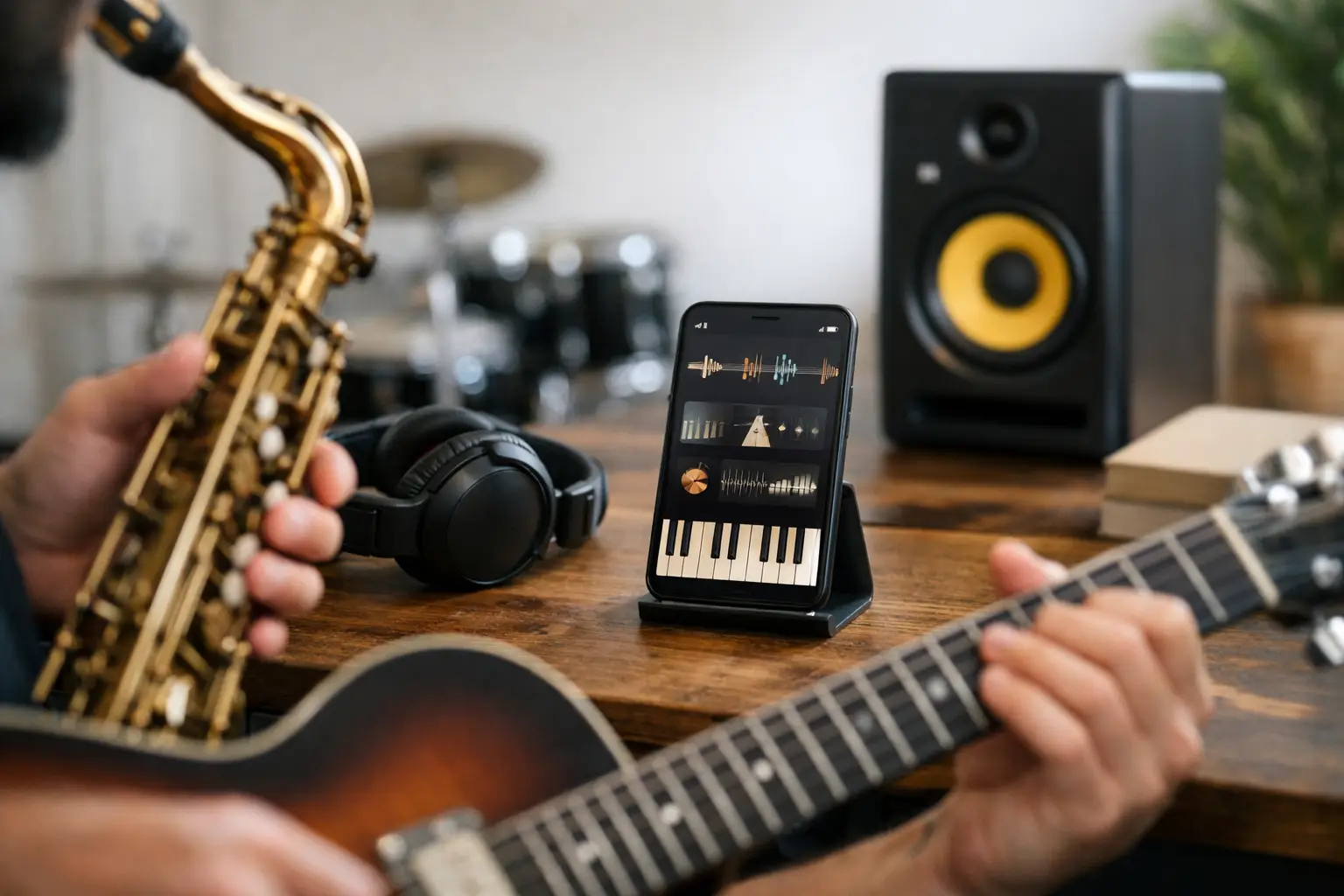
Most musicians do not need more bebop information. They need a better way to practice it. That is exactly where a bebop practice app can make a real difference - not by dumping more theory on the screen, but by turning jazz language into something you can recognize, recall, and use consistently.
Bebop gets treated like a talent test far too often. You either “hear it” or you do not. But that framing makes the whole thing harder than it needs to be. Bebop is a language, and language responds to structured repetition, clear patterns, and active use. If an app helps you do those three things well, it is not just convenient. It becomes a serious practice tool.
What a bebop practice app should actually help you do
The first job of a bebop practice app is not to impress you with features. It should help you internalize vocabulary. That means hearing a line and recognizing its shape. It means seeing a fragment and understanding how it functions. It means practicing an idea enough times that it starts to feel familiar under your fingers and in your ear.
That sounds simple, but many music apps miss it. Some are basically digital notebooks. Others are metronomes with extra menus. Some throw giant libraries of patterns at you without any clear path through them. More material is not the same thing as better learning.
A useful app should guide you from exposure to recall to application. First you encounter a phrase or concept. Then you test whether you can identify it without help. Then you practice placing it in a musical context. That cycle matters because bebop fluency is not built by reading alone. It is built when your brain starts connecting sound, theory, and motion as one thing.
The best bebop practice app feels active, not passive
Passive learning is one of the biggest traps in jazz practice. It feels productive because you are looking at real material, but the actual retention can be very weak. You scroll, you listen, you nod, and two hours later very little stays with you.
A strong bebop practice app should keep you involved. It should ask something from you. Maybe you identify intervals inside a line. Maybe you match sound to shape. Maybe you reconstruct vocabulary from memory. Maybe you work with short musical cells before moving to longer phrases. The format can vary, but the principle stays the same: interaction beats observation.
This is where game-like design can be surprisingly powerful. Not gimmicky points for the sake of it, but clear feedback, gradual challenge, and repeatable wins. When practice feels organized and responsive, people stay with it longer. That matters because bebop is learned through frequent contact, not occasional motivation.
If the app turns practice into a series of small, finishable tasks, it lowers the friction. You are more likely to put in fifteen focused minutes when the path is clear than when the session begins with the question, “What am I even supposed to work on today?”
Why pattern recognition matters more than collecting licks
A lot of players approach bebop by collecting lines. There is nothing wrong with learning vocabulary, but if all you do is stack one phrase on top of another, your progress can feel random. You may know a lot of material and still feel stuck when it is time to actually use it.
A better approach is to train pattern recognition. What kind of motion is happening here? Where is the resolution? How does this fragment connect to the harmony? What is being repeated, sequenced, enclosed, or delayed?
A bebop practice app should help make those relationships visible and audible. That is how vocabulary turns into language. Once you start noticing recurring behaviors instead of isolated phrases, the music becomes easier to organize in your mind. You stop memorizing only by surface detail and start understanding function.
This is especially helpful for beginners and intermediate players who feel overwhelmed by the density of bebop lines. The lines often seem fast and packed with notes, but much of that complexity is built from smaller, learnable components. A good app breaks that complexity into manageable units without making the music feel watered down.
Good design helps you practice more often
Musicians usually blame discipline when practice falls apart. Sometimes the real problem is design. If your materials are scattered, your goals are vague, and every session takes ten minutes to set up, consistency drops fast.
That is why the structure of a bebop practice app matters as much as the content. It should be easy to return to where you left off. It should show what you have worked on and what still needs repetition. It should make the next step obvious.
This is not about making practice mindless. It is about reducing unnecessary decisions so your energy can go into listening, understanding, and playing. The more clearly an app organizes your progress, the more likely you are to build a stable routine.
For many musicians, that routine matters more than occasional long sessions. Ten focused minutes of active recall and recognition every day can do more for your bebop vocabulary than one overloaded weekend practice block. A well-built app supports that kind of momentum.
Features that actually matter in a bebop practice app
Not every useful feature looks flashy. In fact, some of the most valuable ones are the least glamorous.
Clear categorization is a big one. If the app organizes material by concept, function, difficulty, or musical behavior, learning becomes easier to navigate. Random piles of content create random results.
Short training loops matter too. Bebop practice works well in compact cycles because repetition is easier when the task is specific. A phrase recognition exercise, a puzzle-style rebuilding task, or a focused ear-and-theory challenge can all be effective if they are short enough to repeat and clear enough to measure.
Feedback is another major factor. You need to know whether you identified something correctly, but also why it works. The best tools do not just mark answers right or wrong. They reinforce the underlying concept so each repetition builds understanding, not just scorekeeping.
Adaptability also matters. A beginner needs structure and reduced complexity. An advanced player needs speed, nuance, and a way to sharpen weak areas. The right app should not treat all users as if they are on the same page.
What to watch out for
A slick interface does not always mean strong pedagogy. Some apps look polished but leave you doing shallow tasks that never transfer into real musicianship. Others overload users with theory labels and lose the sound in the process.
The trade-off usually comes down to balance. If an app is all fun and no depth, progress stalls. If it is all analysis and no engagement, people stop using it. The sweet spot is a system that makes practice enjoyable while still demanding real musical attention.
It also depends on your goals. If you want a reference library, one kind of app may be enough. If you want to build actual fluency, you need active drills, memory work, listening challenges, and a progression that helps the language stick.
This is why puzzle-based learning can be so effective for jazz. It naturally emphasizes recognition, recall, and relationship-building. Instead of staring at a page and hoping it absorbs through repetition, you interact with musical information and prove to yourself that you know it. That shift is huge.
A modern way to learn bebop without the fog
Bebop does not need to feel mysterious. It needs a practice environment that makes the pieces easier to hear, organize, and repeat. The right app gives you that environment. It turns abstract language into concrete training.
That is the real promise of a good bebop practice app. It helps you move from “I kind of get this” to “I can recognize this, remember this, and use this.” For modern learners, that kind of structure is often the missing link.
If your jazz practice has felt scattered or harder to sustain than it should, it may not be a motivation problem at all. You may just need a tool that makes the language easier to work with, one small win at a time.