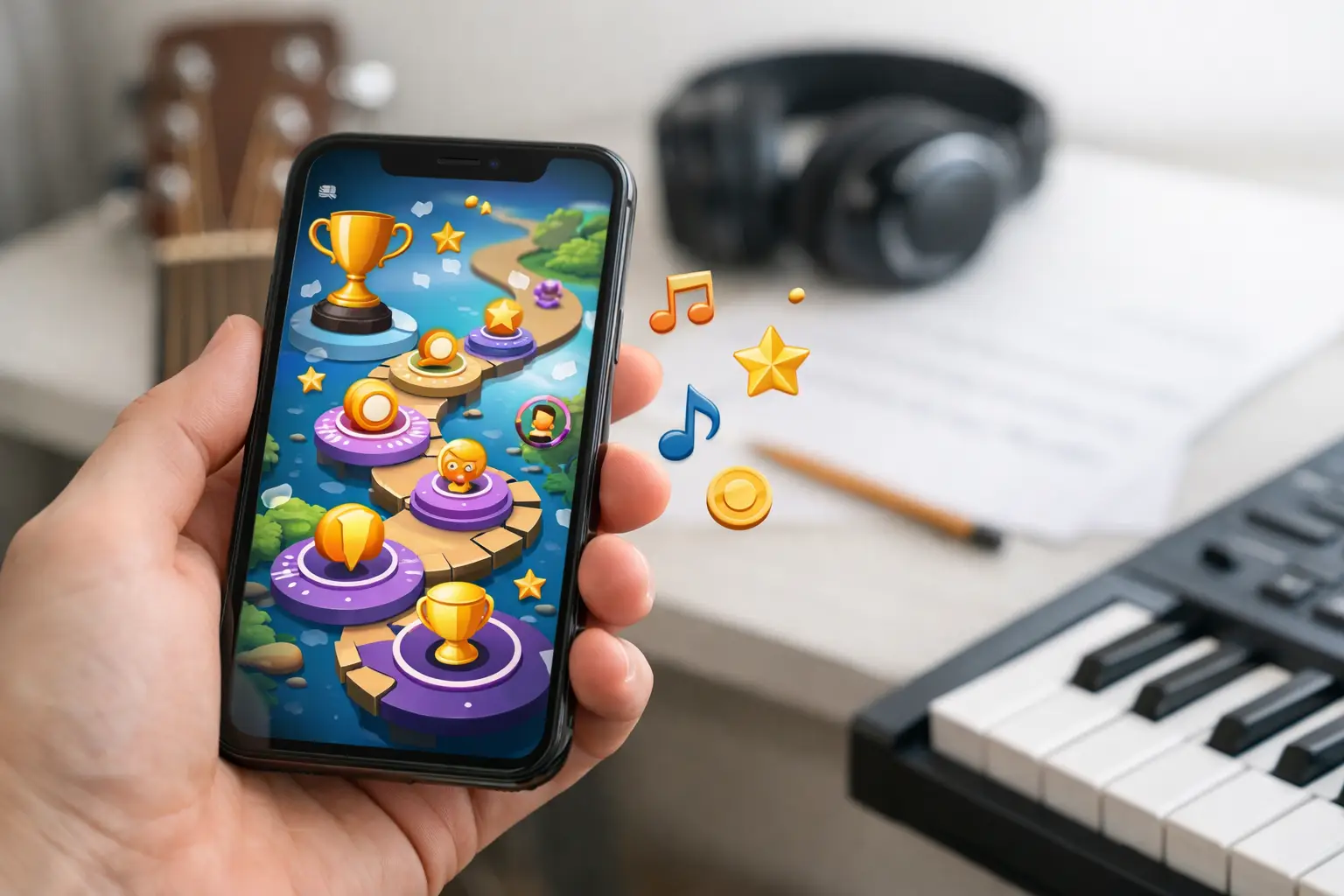
Most musicians do not quit theory because they are lazy. They quit because the usual format asks them to memorize abstract information long before it feels musical. A gamified music theory app changes that sequence. It gives you a clear task, immediate feedback, and a reason to come back tomorrow, which is exactly what most players need if they want theory to stick.
That matters even more in jazz, where the gap between knowing a concept and actually hearing it can feel huge. You might understand chord symbols on paper and still freeze when it is time to recognize movement, spell structures, or connect sounds across keys. When learning starts to feel like solving small musical problems instead of staring at a page, progress gets easier to trust.
What a gamified music theory app actually does
A good gamified music theory app is not just a lesson with points attached. The game layer only works if it supports real musical thinking. That means the app should ask you to identify, compare, sort, recall, and apply information in short cycles that build memory over time.
In practical terms, that often looks like bite-size challenges. You may match chord qualities, recognize interval patterns, organize scale degrees, or complete a harmonic puzzle under light pressure. The point is not entertainment for its own sake. The point is repetition with purpose.
That distinction matters because some apps feel playful but stay shallow. They reward taps, streaks, and speed while skipping the harder part, which is helping you form durable musical associations. If the game mechanics distract from listening, recognition, and recall, the learning ceiling stays low.
Why game mechanics help theory stick
Music theory is often treated like information delivery. But most musicians do not need more information. They need better retention.
Game-based design helps because it breaks big concepts into manageable decisions. Instead of reading three pages about altered dominants or interval relationships, you are asked to solve one small problem correctly, then another, then another. That creates momentum. It also lowers the emotional cost of getting something wrong.
Immediate feedback is a big part of that. When you miss a concept in a book, the mistake can pass unnoticed. In an interactive system, the result is instant. You know whether you recognized the sound, chose the right structure, or confused one function with another. That quick correction loop is how abstract theory starts becoming usable instinct.
There is also a motivation advantage. Most musicians are busy. Even players who care deeply about improving do not always have the energy for long, passive study sessions. A well-designed app makes it easier to practice in ten focused minutes and still feel real progress. That is not a shortcut. It is a better format for consistency.
Why this matters so much for jazz learners
Jazz theory can feel dense because everything connects to everything else. Chord tones relate to guide tones, guide tones relate to voice leading, voice leading relates to harmonic function, and harmonic function shapes melodic choices. If you try to absorb all of that through static explanation alone, it can feel like too much too soon.
A gamified music theory app works well for jazz because jazz fluency depends on recognition. You need to spot patterns quickly. You need to hear relationships, not just define them. You need to remember structures across different contexts until they start feeling familiar.
That is where interactive, puzzle-style learning has a real edge. It lets you practice the same concept from multiple angles without making the experience feel repetitive in a bad way. One exercise might ask you to build a chord. Another might ask you to identify its function. Another might ask you to hear the difference between close options. You are still training one idea, but you are training it actively.
For many musicians, that is the moment theory stops feeling like homework and starts feeling like language practice.
The best gamified music theory app features
The strongest apps do not just keep you busy. They organize your attention.
First, they make progress visible. That does not mean endless badges. It means you can tell what you have practiced, what you are improving, and what still needs work. Clarity is motivating. If a concept feels vague, learners drift. If the next step is obvious, they continue.
Second, they focus on recall, not just recognition. Multiple choice can be useful at first, but it has limits. A serious learner eventually needs to produce the answer, not simply notice it from a list. The best tools gradually shift from assisted learning to active retrieval.
Third, they revisit material intelligently. Repetition is essential, but mindless repetition is frustrating. Good systems bring concepts back at the right moment, often after a short break, so memory gets reinforced instead of flooded.
Fourth, they reduce friction. If opening the app feels like opening a textbook, many players will avoid it. If the path from starting a session to solving a meaningful exercise is fast, practice becomes much easier to sustain.
Where some apps fall short
Not every music app with points, levels, or streaks is helping you become a stronger musician. Some treat gamification as decoration. They make the interface lively but leave the content generic. Others flatten theory into trivia, which can produce quick wins without deeper understanding.
There is also a trade-off between speed and depth. Fast drills can sharpen recall, but if every task rewards rushing, you may train reactions more than listening. That can be useful for note naming or interval labeling, but jazz learning also needs reflection. Sometimes the right answer matters less than understanding why it is right.
Another common issue is poor sequencing. If an app jumps from beginner facts to advanced terminology without a clear path, motivation drops fast. Good learning design feels progressive. You should sense that each challenge prepares you for the next one.
This is especially important for adult learners, who often need both structure and respect. They do not want to be talked down to, and they do not want to waste time. A modern theory app should feel efficient, musical, and thoughtfully organized.
How to tell if an app fits your learning style
If you are choosing a gamified music theory app, start by asking what kind of problem you are trying to solve. Some musicians need help with basic note and interval fluency. Others understand fundamentals but struggle to internalize chord relationships or harmonic movement. The right app should match the level of thinking you want to improve.
It also helps to notice what keeps you practicing. Some learners respond well to streaks and daily goals. Others care more about solving increasingly interesting musical puzzles. Neither approach is wrong, but the app should support your natural motivation instead of fighting it.
And be honest about your tolerance for passive content. If long explanations usually sit unread, you probably need a tool that teaches through interaction first and explanation second. That does not mean theory should be oversimplified. It means the learning format should help you do something, not just read something.
This is one reason puzzle-based systems can be so effective. They turn theory into a series of actions. You compare, place, identify, and recall. With enough repetition, those actions become fluency.
A better way to think about theory practice
Theory practice does not need to feel heavy to be serious. In fact, for many musicians, lighter interaction creates deeper consistency. When an app makes practice clear, structured, and satisfying, you are far more likely to return before forgetting what you learned.
That is the real promise of a tool-driven approach. It respects how musical understanding actually develops. Not in one dramatic breakthrough, but in repeated contact with meaningful material. Short sessions add up. Familiar shapes become recognizable. Confusing concepts become organized. Over time, the language starts to feel less distant.
That is also why The Jazz Puzzle approach makes sense for so many players. It treats jazz as learnable, not mystical. It gives musicians a system for interacting with the material until recognition, recall, and understanding begin to reinforce each other.
If theory has felt dry, slow, or hard to retain, the problem may not be your ability. It may be the format. The right app will not make music effortless, and it should not pretend to. But it can make practice more focused, more repeatable, and a lot more rewarding. That is usually where real progress begins.